


.svg)
.svg)


Simplify your customs today
Calculate duties and taxes

.avif)
.avif)
.svg)
Streamlining customs clearance

.svg)
.svg)
.svg)
.svg)
import into canada
Import into the USA
.avif)
© 2026 Borderbuddy, All rights reserved.
Designed by SupaStellar


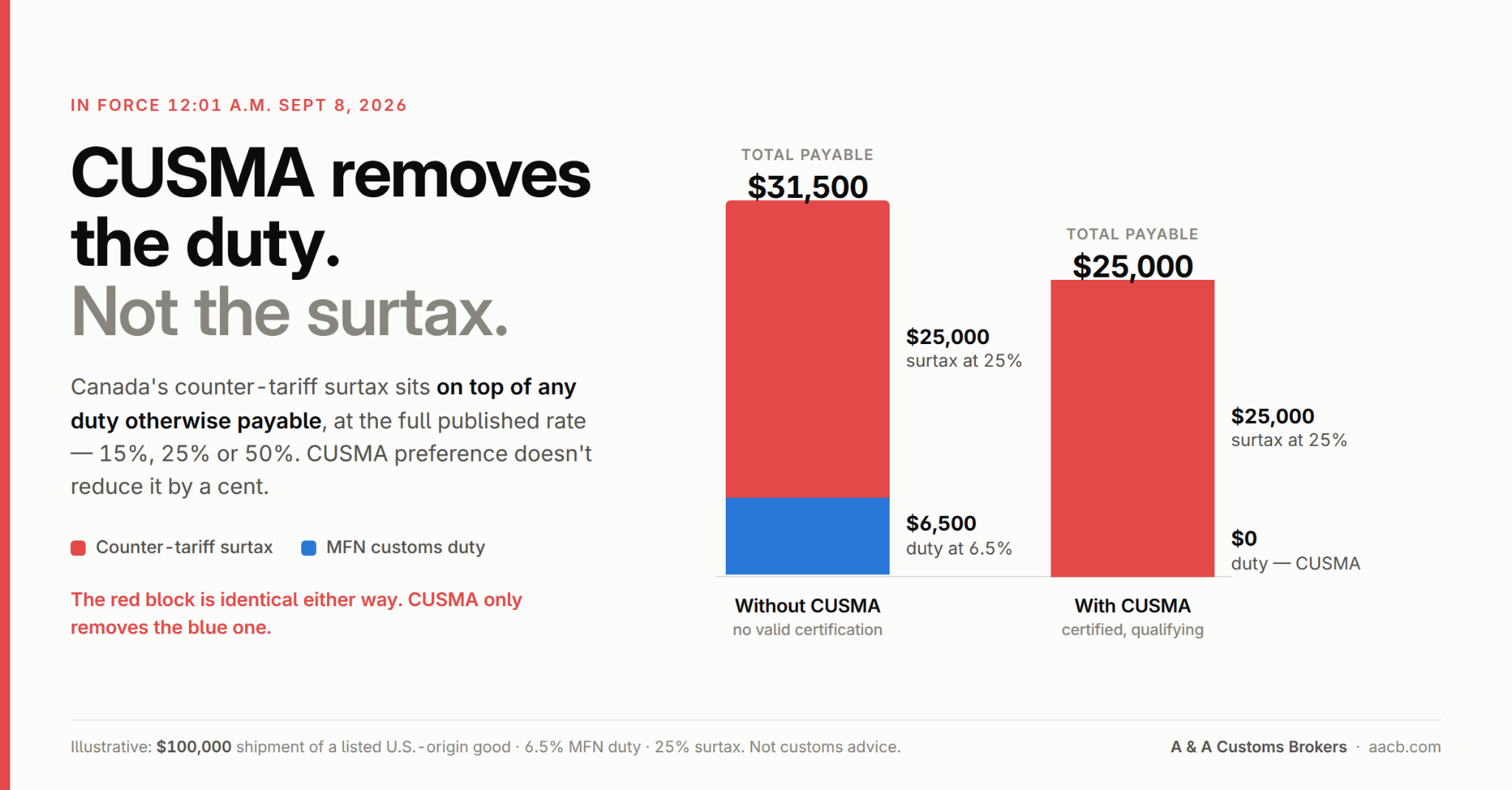
Canada's counter-tariffs take effect at 12:01 a.m. on Tuesday, September 8: surtaxes of 15%, 25% and 50% on roughly $27.6 billion in U.S.-origin goods, each rate matched to the corresponding U.S. Section 232 or Section 338 rate. Steel, aluminum, dairy, appliances, agricultural equipment, pulp and paper, plastics and electronics are all on the list somewhere.
Two questions have dominated our inbox since the list came out: does CUSMA get me out of this? and what about remission? Short answers: no, and not yet.
CUSMA reduces or eliminates the ordinary customs duty — the "MFN rate". It does nothing to the surtax, which sits on top at the full published rate. A good that enters duty-free under CUSMA and is listed for surtax at 25% will pay 25% - regardless of CUSMA status.
Remission is the government agreeing to waive or refund a duty you legally owe. It doesn't change the tariff — the surtax still applies to your goods. It's a separate instrument, made by Order in Council under section 115 of the Customs Tariff, that relieves you of paying it.
Ottawa considers requests where inputs can't be sourced domestically or reasonably from non-U.S. suppliers, or where exceptional circumstances would severely harm the Canadian economy. The bar is high by design.
The legal test is one thing; the record since the surtaxes began is more useful.
The throughline is production, not consumption: relief flows to inputs that keep Canadian plants, farms and hospitals running, not to finished goods imported for resale. And it's typically transition timeboxed, and not a permanent exemption — hence the sunset dates.
Requests go to Finance Canada at remissions-remises@fin.gc.ca, subject line "U.S. Remission"; only Canadian-registered companies can apply. Finance's template asks for a file, not a letter — tariff items, volumes and values, unit costs, employment effects, named competitors, and above all evidence of failed sourcing attempts.
No Order covering these counter-tariffs has been published yet.
Finance Canada has signalled it intends to extend relief under the existing United States Surtax Remission Order (2025), subject to Governor in Council approval. If so, existing product- and company-specific remissions carry over on their current terms, and the horizontal categories cover goods imported before July 1, 2027. Nothing is in force until the Order is published. Expect a CBSA customs notice with the administrative detail (hopefully before Sept-8, but unlikely); we'll update as soon as it lands.
Until then: classify accurately, pay the surtax, and keep the records you'd need to claim it back.
Chart is illustrative: $100,000 shipment of a listed U.S.-origin good, 6.5% MFN duty, 25% surtax. This article is general information, not customs advice.