


.svg)
.svg)


Simplify your customs today
Calculate duties and taxes

.avif)
.avif)
.svg)
Streamlining customs clearance

.svg)
.svg)
.svg)
.svg)
import into canada
Import into the USA
.avif)
© 2026 Borderbuddy, All rights reserved.
Designed by SupaStellar


Most of what we deal with in customs is a number.
The rate goes up. The rate goes down. You recalculate, tell the client, and they adjust their pricing or sourcing. Painful, but tractable.
The September 8 proclamations did something different—and I don’t think many importers have caught it yet.
There are two dates, and they are not the same kind of event.
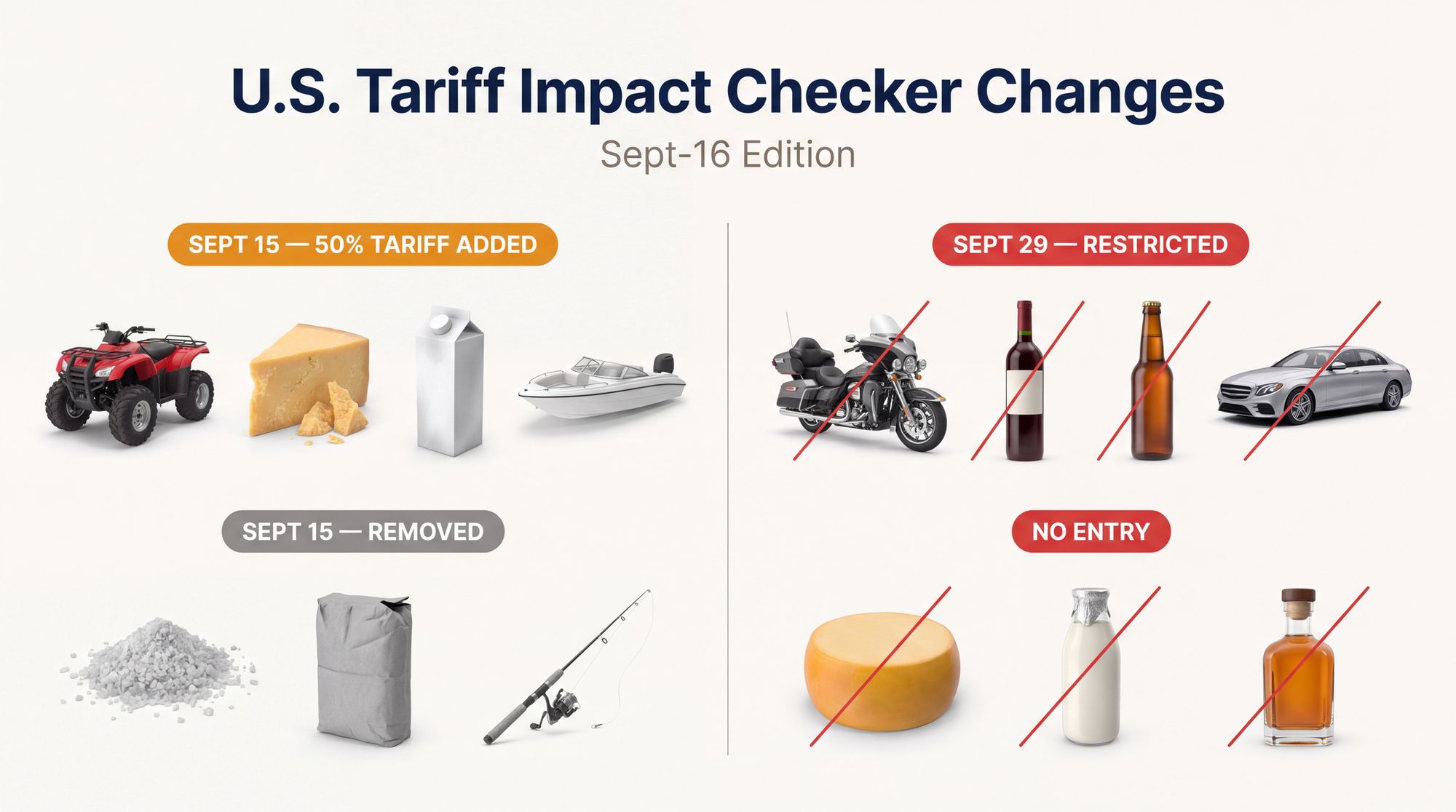
Another 122 HTSUS classifications were added to the Canadian goods subject to the 50% Section 338 duty. Several existing classifications were removed or narrowed, including rock salt, cement and selected spirits and fishing-rod lines. All-terrain vehicles were added. More dairy products were added.
If you import one of these products, your landed cost changes and you deal with it the way you have dealt with every other rate change this year.
For specified products within the dairy, alcoholic beverage and motor-vehicle measures, the 50% duty is replaced by an import prohibition.
Not a higher number. No number at all.
The goods don’t come in.
That distinction matters more than it sounds like it should. A 50% duty is a margin problem—you can absorb it, split it, pass it through or find another supplier over the next two quarters.
A prohibition is an operations problem, and the clock is now under two weeks.
It also matters because USMCA doesn’t protect goods from these Section 338 measures. A qualifying USMCA claim may still affect the ordinary duty or the application of other trade measures, but it does not remove the Section 338 tariff or prohibition.
I’ve had three conversations this month with importers who assumed their CUSMA certification was a shield. For Section 338, it isn’t.
We built the Tariff Impact Checker in the spring to answer one question:
Enter an HS code and get a number.
Since then, we’ve continued extending it—first for the Canadian counter-tariffs that took effect September 8, then with before-and-after comparisons so you can see the difference rather than only the endpoint, and then with an editable declared value so you can model your real shipment instead of a hypothetical one.
This release added something we honestly hadn’t planned for: support for restricted goods.
We built the tool on the assumption that the measures we needed to model would be rates. When the prohibitions were announced, the tool would have cheerfully quoted a duty percentage for a product that would not be permitted into the country.
That is worse than useless because it is confidently wrong.
So now the tool tells you. If your classification is restricted rather than tariffed, you get that answer—in those words.
If there is one lesson from the past six months, it is that the shape of the measure changes as often as the number does. We’ve had ad valorem duties, statutory maximums, forced-labour actions, quota disputes and now outright import bans—all within roughly a year.
Anyone building a compliance process around “check the rate” is eventually going to be surprised.
The checker is free. There is no login and no form standing between you and the answer.
Run your codes. If you import dairy, alcohol or vehicle-related products, run them today.
The useful side of the September 29 date is the side we’re still on.
https://www.borderbuddy.com/tariff-impact-checker