


.svg)
.svg)



































.png)
















Simplify your customs today
Calculate duties and taxes

.avif)
.avif)
.svg)
Streamlining customs clearance

.svg)
.svg)
.svg)
.svg)
import into canada
Import into the USA
.avif)
© 2026 Borderbuddy, All rights reserved.
Designed by SupaStellar


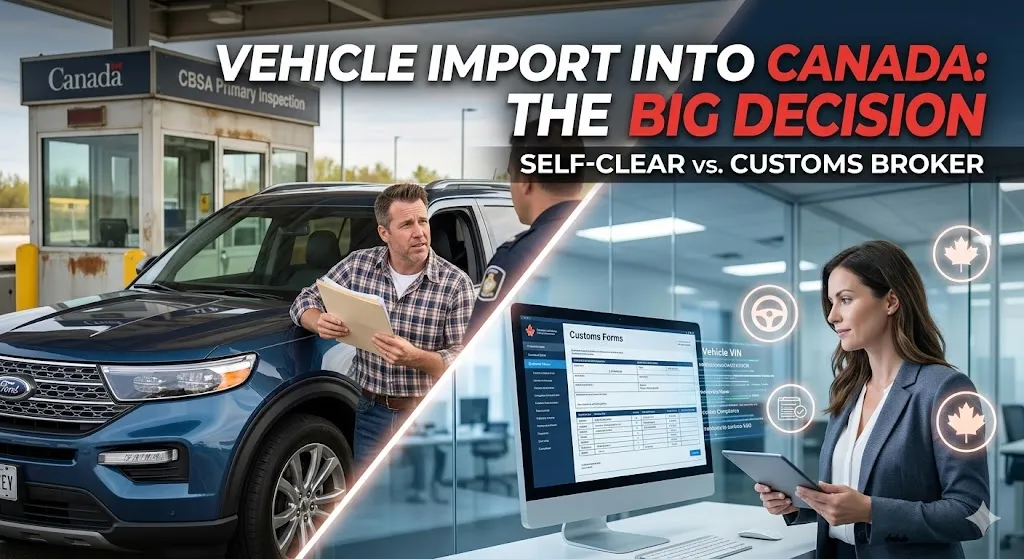
When importing a vehicle into Canada, one decision consistently shapes how the rest of the process unfolds:
Should you clear the car yourself or use a customs broker?
This question usually comes up when:
This post explains the difference between self-clearing a vehicle and using a broker in Canada, based entirely on how this choice actually plays out in real vehicle imports.
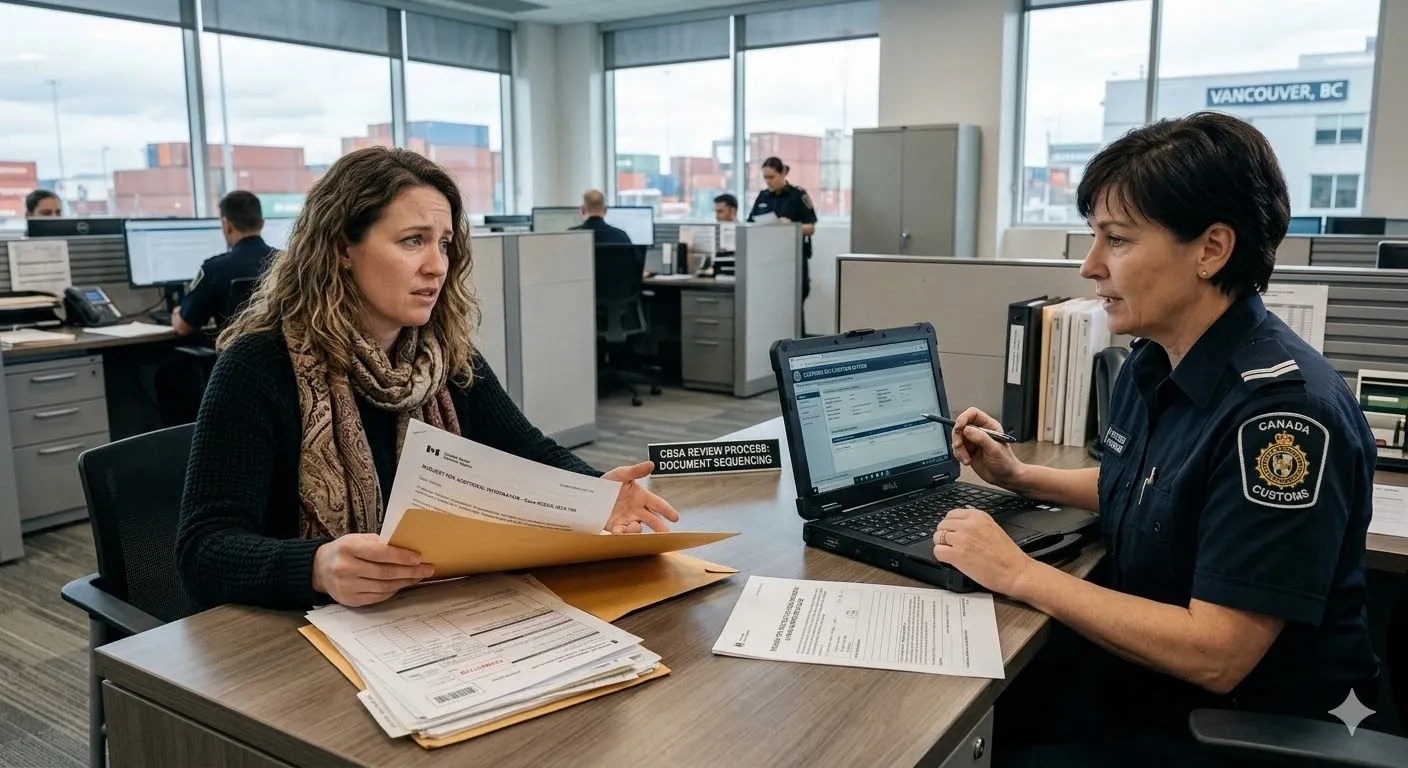
Self-clearing means you deal directly with CBSA to clear the vehicle. That includes:
Self-clearing is allowed in Canada, but it assumes you understand what CBSA expects and are prepared to manage the process yourself. Self-clearing generally requires you to appear in person at a CBSA office, coordinate release paperwork with the carrier, and manage timing at the port of entry. For many importers, the process is less about difficulty and more about logistics.
Using a broker means a customs professional manages the clearance process on your behalf. That typically includes:
A broker does not change CBSA’s rules, but they help ensure the vehicle is presented in a way that allows CBSA to process it efficiently. A broker cannot override CBSA decisions or skip admissibility requirements. What they can do is reduce preventable delays by making sure the vehicle is declared correctly the first time.
If the vehicle is being imported commercially or tied to a business BN/RM account, broker involvement is often the smoothest path because the clearance process is more formal and compliance-driven.
Based on what we see repeatedly in real vehicle imports, vehicle imports behave differently from most other goods:
This is why people importing vehicles revisit the self-clear vs broker question more often than for other shipments.
Self-clearing can work when:
In these situations, self-clearance can be manageable if everything is done correctly from the start.
Based on real outcomes, a broker is often the better option when:
Many vehicle imports that start as self-cleared end up involving a broker once problems surface.
It is possible to switch from self-clearing to using a broker after shipping, but it often:
Most issues tied to this decision stem from making it after the vehicle reaches the border rather than before.
This is a key point that surprises many people. Whether you self-clear or use a broker:
A broker manages the process, but legal responsibility stays with the importer.
Many people choose self-clearance to save money. What shows up repeatedly is that:
The real cost difference often becomes clear only after issues arise. For vehicles, the cost of one extra week in storage or a failed clearance attempt usually exceeds the cost of using a broker upfront.
Self-clearing a vehicle is possible in Canada. Using a broker is often more predictable.
The right choice depends on:
For vehicle imports, this decision shapes how smoothly or painfully the process goes.
Use the BorderBuddy duty and tax calculator to get a quote. It’s the fastest way to understand total landed cost before problems start. BorderBuddy’s calculator also uses AI to help classify goods under the correct HS (Harmonized System) code, a key factor in determining the duty rate applied to an import.
People deciding between self-clearance and using a broker usually ask next:
If you still didn’t find what you were looking for, BorderBuddy is here to help.
Our team can help you get clear answers and avoid delays at the border.

.svg)
.svg)